Waiting for the Hem: On Commissioning a Garment for the Decade Ahead

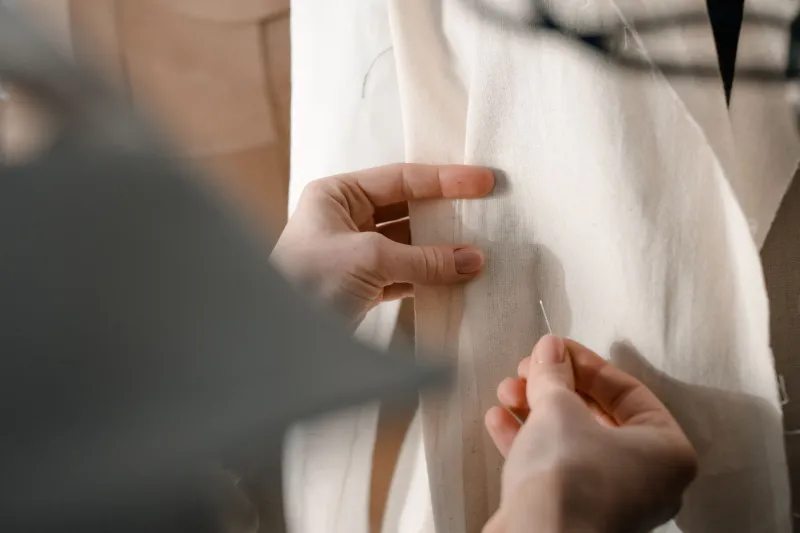
Photo: tailor fitting room made to measure dressmaker pins mirror atelier, via as2.ftcdn.net
There is a particular quality to a fitting room in a Melbourne workroom: the hush of it, the pins in a pincushion like a quiet clock, the mirror angled so that you see yourself slightly before you are ready to. It is a room defined by deferral. Nothing here can be taken home today.
For a growing number of women across the city — from the terrace houses of Carlton to the weatherboard streets of Malvern — that deferral has become the point. They are commissioning garments rather than purchasing them, entering into arrangements that begin with a conversation and a tape measure and end, three or six or occasionally twelve months later, with a single piece of clothing made to their body and their life. In an economy engineered for immediacy, they have chosen to wait.
The Long Order
Made-to-measure is not a new idea in Melbourne. The city's tailoring traditions run deep, from the menswear houses that served generations on Collins Street to the dressmakers who have quietly worked out of arcades and suburban studios for a century. What is new is who is commissioning, and why.
The clients arriving at these workrooms now are often younger than the stereotype suggests. They are not, by and large, preparing for an occasion. They are preparing for a decade. The coat commissioned this autumn is intended to be worn — repaired, altered, worn again — until the middle of the 2030s. A tailored trouser is ordered knowing the body will change and trusting the maker to accommodate it. The garment is conceived, from the first fitting, as a long resident of the wardrobe rather than a visitor.
One client, a Fitzroy architect in her late thirties, describes the process in terms that would not be out of place in her own profession. "You brief it like a building," she says. "You discuss the site — which is your body, your commute, your climate. You approve the plans. Then you wait for the build. You would never expect a house in six weeks."
The Psychology of the Wait
What does waiting do to a wardrobe? Economists would call it a commitment device — a structure that makes impulse difficult. When a garment exists only as a chalk line and a promise, there is nothing to impulse-buy. The decision was made months ago, in daylight, with deliberation. By the time the piece is finished, the appetite that produced it has either matured into certainty or quietly dissolved. Mostly, it matures.
The makers notice this. Several describe clients who arrive at their first fitting in a state of wardrobe fatigue — tired of rails of clothes that fit imperfectly and mean little — and who leave the third fitting speaking differently about what they own. The act of being measured, of choosing a lining, of deciding how a sleeve should break, appears to recalibrate a person's relationship with everything else hanging in the closet.
There is, too, the matter of accountability. A commissioned garment carries the maker's name alongside the wearer's. Neither party wishes to be disappointed. The result is a level of care on both sides of the needle that off-the-rack retail, structurally, cannot replicate.
Ten Years Is a Design Brief
Designing for a decade imposes discipline. Fabrics must be chosen for their second and third year, not their first wear — mills and weights that soften rather than collapse. Silhouettes must sit slightly outside the moment, neither chasing a trend nor wilfully ignoring it. Construction must anticipate repair: generous seam allowances, replaceable buttons, hems with room to move.
This is not nostalgia dressing. The best of the current workrooms are thoroughly contemporary in their thinking — sustainable wools from Australian mills, natural fibres chosen for a climate that swings from northerlies to southerlies in an afternoon, cuts informed by the lives women actually lead rather than a runway fiction. The ten-year garment is not a costume. It is infrastructure.
Whether a single coat can change how a person dresses is, of course, an open question. But the evidence of the waiting rooms suggests something subtler: it changes how a person buys. Women who commission rarely return to the impulse rack with the same ease. Once you have waited four months for a sleeve to be set properly, the disposable alternative reads differently — like a photocopy of a letter you once received by hand.
A Different Sort of Luxury
In Melbourne, where the sartorial culture has always favoured restraint over display, the commissioned garment may be the most natural expression of the city's taste. It is not loud. It does not announce its price. Its luxury lies in fit, in provenance, in the knowledge that a specific pair of hands made this thing for this person.
The wait, in the end, is the point. A garment that arrives after months of anticipation is not an acquisition; it is an arrival. And arrivals, unlike acquisitions, are remembered.
The second fitting is where it begins to feel real — the chalk line becoming cloth, the possibility becoming a thing with weight and drape and a future. The women who commission are, in effect, writing letters to their future selves. The postmark is Melbourne. The delivery date is a decade away.