Pinned and Speaking: The Confessions of the Fitting Room
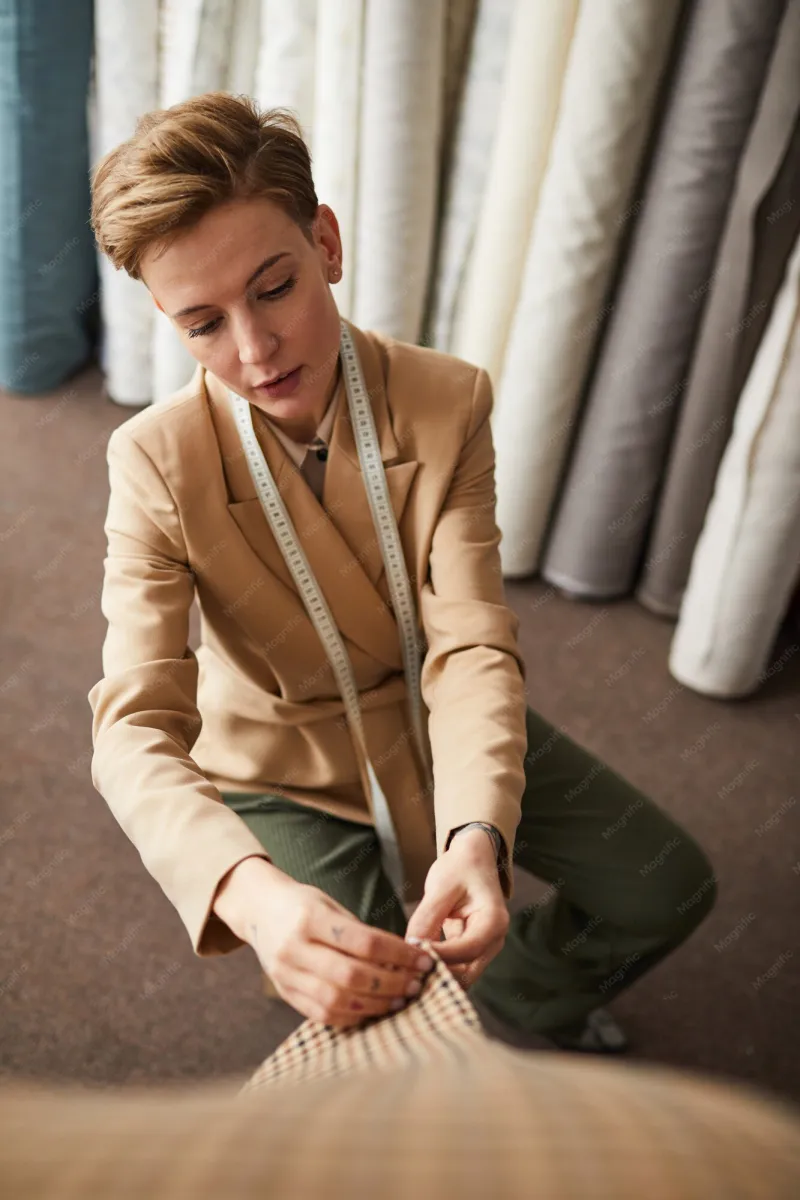
Photo: tailor pinning dress on client in fitting room studio, via img.freepik.com
There is a particular hour in the life of a garment that never appears in the lookbook. It happens after the pattern is cut and before the final press, when the half-finished piece is pinned to a standing body and the conversation turns — almost always — away from the clothes.
Ask any experienced fitter in Melbourne and they will tell you the same thing: the second fitting is rarely about the garment. It is about everything the client has carried into the room.
The Room Where Arms Stay Raised
The mechanics of a fitting create an unusual intimacy. Arms are held aloft for minutes at a time. A stranger kneels at your hem with a mouthful of pins. You cannot check your phone, cannot retreat behind a counter, cannot do anything at all except stand in a partially constructed garment and talk.
Marguerite, who has altered and made-to-measure from a first-floor studio off Bourke Street for over two decades, describes it plainly. "People arrive with a garment and a body. Within ten minutes they've given me their mother's story, their divorce, their new job. The pins come out and so does everything else."
It is not that clients lack discretion elsewhere. It is that the fitting room removes the performance. There is no outfit to present, only a body in progress and a professional seeing it exactly as it is. That kind of witness is rare in modern life, and people respond to it.
What Gets Said
The confessions follow patterns. Women speak of weights gained and lost — not as numbers, but as seasons of a life. A dress commissioned for a daughter's wedding in the Yarra Valley becomes the occasion for talking about the daughter herself, and the marriage, and the years between. A coat taken in becomes the marker of a winter survived.
One client, a surgeon from Parkville, told her fitter mid-hem that she had not worn colour since her father died. She was commissioning a green wool dress. The fitting took three sessions. The conversation took all of them.
Fitters, as a profession, are keepers of this material. They are bound by the same discretion as doctors or hairdressers, and most take it seriously. What emerges from their accounts is a portrait of how Australian women actually relate to their wardrobes: not as decoration, but as biography.
The Mirror Problem
Many studios deliberately delay the mirror. The client is pinned, chalked, measured — and only turned toward the glass once the garment is resolved. The reason is practical on the surface: a half-finished garment looks wrong, and premature judgement distorts the fitting.
But there is something else at work. Several fitters admitted the delay is also a kindness. The mirror confronts. The conversation does not. In the window between pinning and seeing, a woman can speak about her body without looking at it — and often with more honesty than she manages in front of the glass.
"By the time I turn the mirror around," Marguerite says, "she's already told me who she is. The mirror just confirms it."
Why This Matters to How We Dress
There is a lesson here for anyone who buys clothes rather than commissioning them. The intimacy of the fitting room reveals what we actually want from our garments: to be seen accurately, to be held comfortably, to mark something.
Fast fashion offers none of this dialogue. The change room on a Saturday afternoon in the CBD is a place of hurried judgement and poor light — the opposite of the second fitting's slow honesty. It is worth noticing which of those rooms leaves you feeling more like yourself.
Perhaps that is the quiet argument of Melbourne's remaining makers. Not that every woman should commission a garment, though the city's tailors would not object. But that the relationship between a woman and her clothes deserves an hour of real conversation — and that the most truthful things we say about ourselves are spoken with our arms raised and a stranger's pins in our hemline.
The garment, in the end, carries the memory of that hour in its seams. Which may be why the clothes we have made last so much longer than the ones we merely bought.