The Measured Life: Inside the Rooms Where Melbourne Still Sews to Fit
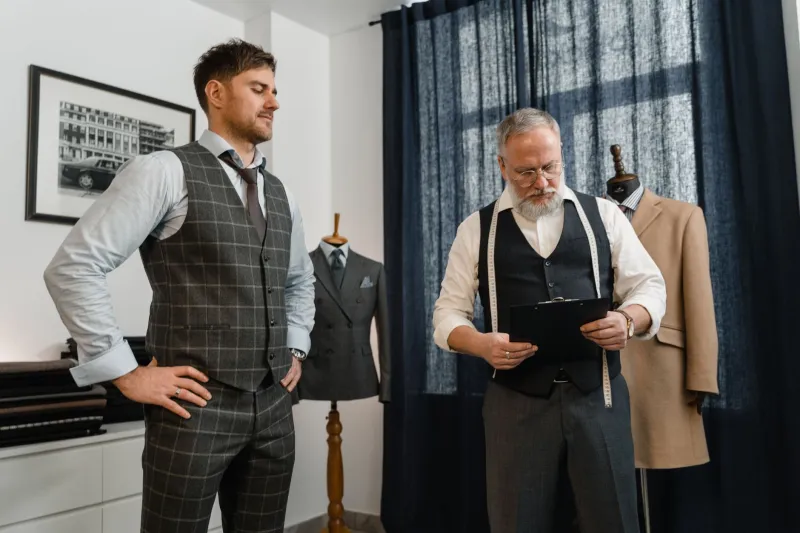
There is a particular sound a tailor's chalk makes against wool — a dry, decisive scrape that no e-commerce notification has ever replicated. You hear it in a handful of rooms across Melbourne: above a laneway off Little Collins, behind a curtain in a Malvern arcade, in a Brunswick basement where three generations of one family have cut trousers for men who then sent their sons.
These rooms survive. That is the remarkable thing. Not because the market rewards them — it largely does not — but because a certain kind of shopper never entirely left.
The Arithmetic of Permanence
The economics are unforgiving and worth stating plainly. A made-to-measure garment might cost four or five times its off-the-rack equivalent. It takes weeks, sometimes months. There is no tracking number, no next-day courier, no dopamine of the doorstep.
And yet the calculus changes the moment you extend the timeline. A $240 shirt worn sixty times costs $4 per wear. A $900 shirt, cut to your shoulder and worn three hundred times over a decade, costs $3 — and looks better on the two-hundred-and-fiftieth wearing than the fast version did on its tenth. Melbourne's tailors have never needed to explain this to their customers. The customers arrive having worked it out themselves, usually after a decade of buying cheaply and repeatedly.
The Backroom Economy
What struck us, visiting these workshops, is how little they advertise and how fully they are booked. The alterations room on the corner of a suburban strip — the kind with a hand-lettered window and a bell above the door — runs on referrals passed between mothers, colleagues, golf partners. The CBD cutter with a four-month waiting list has never run a promotion. Their websites, where they exist at all, are afterthoughts; the work speaks through the wearer.
There is something quietly radical in this. In an industry that spends billions convincing us our wardrobes are perpetually insufficient, the tailor's proposition is the opposite: that the garment you already own, adjusted by two centimetres here and a shoulder there, might be the best thing you possess.
Why the Measuring Tape Is Returning
Three forces are converging in the tailor's favour. The first is fatigue — a generation of Australian shoppers has cycled through enough disposable fashion to recognise the pattern. The second is the body itself: as anyone who has shopped online knows, standardised sizing is a fiction, and the tailor's tape is the only honest measurement there is. The third is sentiment, or something adjacent to it. A garment made for you carries information. It remembers your posture, your preferred break at the shoe, the shoulder you favour when you carry a bag.
What We Owe These Rooms
If there is a plea to be made, it is this: use them before they are gone. Bring the coat that almost fits. Have the trousers taken in rather than replaced. The average alterations job costs less than a delivery dinner and extends the life of a garment by years — a transaction so obviously sensible that its neglect can only be explained by habit.
Melbourne has always fancied itself a city of quiet quality rather than loud logos. The tailors' rooms are where that self-image is actually made — literally, stitch by stitch, at a pace the rest of the fashion economy can no longer comprehend. Long may the chalk scrape on.